
How to Make a Small Room Feel Bigger: Start With the Eye Test
Why a Room Can Feel Smaller Than It Is
Two rooms can be exactly the same size and feel nothing alike. One feels open and easy. The other feels like a closet with a couch in it.
The difference usually comes down to what your eye does when you walk in. If the light stops halfway across the room, if your gaze keeps bumping into things, or if one big dark piece soaks up all the attention, the room reads as small, even when the square footage is fine.
The good news is that most of this is cheap to fix. The trick is figuring out what’s actually making your room feel tight before you buy anything. That’s what this guide is for. If the real problem is where things sit, start with my Furniture Layout guide. If it’s a lack of storage, see my guide to using vertical space.
The Eye Test
Stand in the doorway, hold your phone at eye level, and take one photo of the room. Don’t tidy up first.
A photo flattens a room and shows you things you stopped noticing months ago. Look at it and ask three questions.
| Question | What to look for |
|---|---|
| Light? Where does the light stop? | Dark corners, one harsh overhead fixture, a window that’s half blocked. |
| Lines? Where does your eye travel, and where does it stop? | A rug that ends too soon, a big piece in the way of the far wall, patterns and color breaks that chop up the view. |
| Weight? What looks heaviest? | A bulky dark sofa, thick drapes, a wall packed with stuff. |
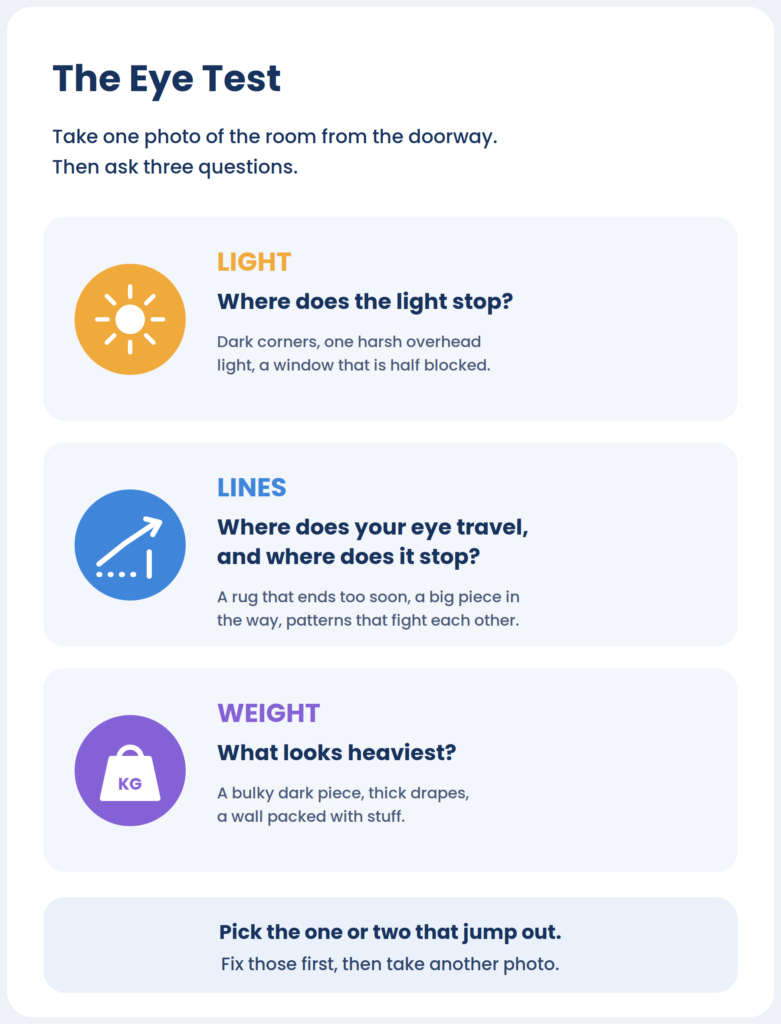
“Lines” is the one most people skip, so here’s what I mean. Your eye likes to travel. In a good room, it can run from the door across the floor, up the curtains, and out the window. In a tight one, it keeps hitting walls: a rug that stops short, a bookcase in the way, three patterns fighting for attention. Where your eye stops is where the room starts to feel small. It’s a rule of thumb, not a law of physics, but it’s a handy one.
Pick the one or two answers that jump out at you. Fix those first, then take another photo. A single change can make more of a difference than you’d expect.
Six Ways to Make a Room Feel More Open
You won’t need all six. Start with whatever the Eye Test pointed to.
1. Add Light Where It Stops
Helps with: Light
A single overhead fixture can leave the corners dark and make the room feel flat. Add a second or third light at a different height: a floor lamp in a dim corner, a small lamp on a shelf. Warm white bulbs keep the room cozy in the evening.
Even a small light does a lot. The corner shelf in my place has built-in lights, so that corner stays part of the room after dark instead of fading into the wall.
2. Hang Curtains Higher and Wider
Helps with: Light, Lines
Most people hang the rod right above the window frame. Try mounting it close to the ceiling and letting the panels hang outside the frame, which can make the room feel taller and the windows look larger. Open them all the way during the day so the whole window shows. resident
Lighter fabrics help too, since sheer curtains with the window open make a space feel bigger. If you need blackout curtains for sleeping, that’s fine. Just hang them high and pull them fully open in the morning. bhg
3. Use a Mirror, but Think About What It Shows
Helps with: Light
A mirror shows whatever sits in front of it. Across from a window, it bounces daylight deeper into the room. Across from a messy bookshelf, it doubles the mess.
Before you hang one, stand where it would go and look at what it would reflect. And if it’s big, mount it properly. My vertical storage guide covers mounting safety.
4. Keep Your Colors Connected
Helps with: Lines
You don’t have to paint everything white. What helps is fewer breaks. In one study using virtual rooms, light ceilings and light walls made a room look taller, while the color of the floor had a weaker effect. sagepub
In practice, that means one main wall color, trim that doesn’t fight it, and curtains close to the wall color so they blend in rather than cut the wall in half. Dark can work too. Some designers argue that going darker can make a small living room feel bigger. It just won’t make the room brighter, so decide which effect you want. livingetc
5. Let the Floor Lead the Eye
Helps with: Lines, Weight
The floor does more than hold up your furniture. It can also show your eye which way the room goes.
In a narrow living room, try a runner or rug that follows the longest side. It gives your eye a direction to follow and makes the floor feel more continuous. Many designers also suggest one large rug instead of several small ones, especially in a seating area where the front legs of the sofa and chairs can sit on it. Without a rug like that, every piece looks like its own little island. willowandhall
If the room already feels crowded, look at what’s sitting right on the floor. Furniture with visible legs lets some of it show through, which can make a space feel lighter. You don’t have to bare every inch. Just aim for a floor and furniture that read as one room instead of a pile of separate pieces.
6. Lighten the Visual Weight
Helps with: Weight
Some pieces just look heavy: a bulky dark console, a sofa with huge arms, a bookcase that goes dark and chunky from floor to ceiling. Swapping one of them for something lighter often changes a room more than a new paint color.
Count your pieces too. Too many small seats and storage pieces can make a room feel cluttered and tight. Every piece takes up visual space as well as floor space. For help with sizing and placement, see my Furniture Layout guide. resident
When Common Tricks Backfire
A few popular fixes can make things worse:
- A mirror facing clutter. It just doubles what you’re trying to hide.
- A rug that’s too small. The furniture ends up looking like it’s floating, and the room feels chopped up.
- Heavy dark curtains that stop at the window frame. They make the window look smaller and block daylight.
- Too many patterns and colors. If every surface competes for attention, your eye has nowhere to rest.
- Going all white and bare. A room with nothing in it can feel cold instead of open.
Keep It Feeling Like Home
A small room doesn’t have to look like a showroom. Keep the things you love, and let a few of them stand out. I’d rather walk into a small room with a handful of things that mean something than a bare one that only looks good in photos.
You’re aiming for a room that’s easy on the eye and still feels like yours.
Your 5-Minute Checklist
- I took a photo from the doorway and looked at it honestly.
- Light reaches every corner of the room.
- My eye can travel from the door to the far wall without hitting anything big.
- My curtain rod sits high, and the panels hang clear of the glass.
- My mirror reflects a window or a calm wall.
- I’m using only two or three main colors.
- My rug is big enough, and I can see some floor around it.
- I lightened or moved the one piece that looked heaviest.
Once the room feels open, you can decide what else it needs. If it’s storage, my guide to [link: using vertical space] shows where to find it without giving up floor space.